
Decades of teaching, practice, reflection and refinement.
Practitioner Training
Learn the work deeply. Understand the responsibility it carries
Structured professional education grounded in embodied practice, sexuality, participant authority and ethical responsibility.
Formal professional education
A home for training that has substance behind its name
Practitioner Training is where Andrew’s defined professional education pathways live.
Programmes presented here have a structured curriculum, eligibility and suitability criteria, professional standards, practice and feedback, learning outcomes and clear completion requirements. Professional Mentoring serves a different purpose: it develops the practitioner and the work they already offer.
Tantric Body De-armouring is the current flagship training. Further professional education will appear only when its curriculum, assessment and certificate framework are genuinely ready.
A progressive residential training with practice and assessment.
Technique is learned within consent, judgement and scope.
The current flagship
Tantric Body De-armouring Practitioner Training
A professional and personal journey into release, sexual restoration and capacity expansion.
Tantric Body De-armouring is a participant-centred approach to embodied change. Practitioners learn to create and maintain a professional container while the participant remains the authority over their own body, boundaries, experience and choices.
This is not a collection of techniques performed on another person. It develops the knowledge, sensitivity, communication, self-awareness and professional judgement needed to meet the person in front of you.
The Three Stages
From release, to restoration, to expansion
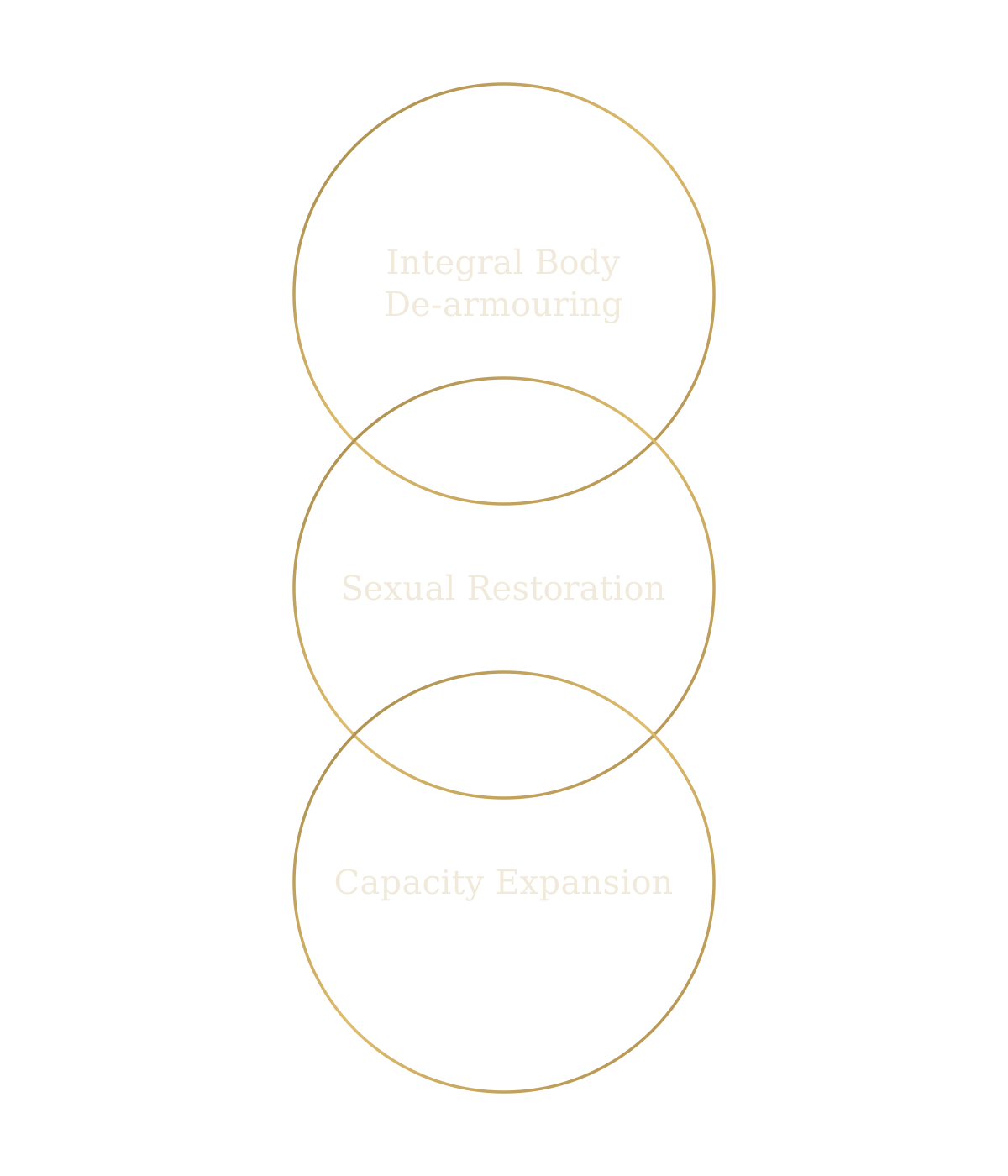
The Three Stages describe how the work can unfold over time: first releasing held patterns in the body, then restoring access to sexual feeling and aliveness, and finally expanding the capacity for pleasure. They are a pathway rather than a timetable, and each person moves through them according to their own readiness.
Integral Body De-armouring
In this foundational stage, the participant remains in underwear while the work stays with non-genital areas of the body. Practitioners learn to support body awareness, communication, boundaries and the release of held tension without imposing a predetermined session.
Sexual Restoration
When the foundations are in place and the participant is ready, the work may move into pelvic, genital, yoni, lingam or prostate de-armouring. Its purpose is to gently restore access to sensation, feeling, pleasure and sexual aliveness in ways that are chosen and consented to.
Capacity Expansion
Building on the first two stages, Purposeful Pleasure practices support the participant to expand their capacity for desire, arousal, pleasure, orgasmic energy and integration. The direction is chosen together and develops at a pace the body can genuinely hold.
Progression is guided by readiness, capacity, informed choice and professional assessment, not by a fixed number of sessions.
The Four Core Principles
How the work is practised matters
The principles are not decorative values. They shape communication, pacing, consent and professional decisions throughout training and practice.
Optimal Challenge Zone
The work stays within a level of challenge that can invite meaningful change while the participant remains present, communicative and able to choose. More intensity is not assumed to mean better work.
Progressive Approach
Each stage builds on the foundations developed before it. Progress follows the participant’s readiness and capacity, with earlier-stage work always available whenever it is needed.
Collaborative Process
Practitioner and participant work together through communication, observation and feedback. Practitioner knowledge guides the process without replacing participant authority.
Activation-Integration Cycle
Moments of activation are followed by time to settle, notice and integrate. This rhythm allows experience to become embodied learning rather than something the participant simply moves through.
What practitioners learn to hold
More than technique
Practical skill is taught alongside sexuality knowledge, professional power, participant choice, scope and continuing responsibility.
Knowledge and understanding
Embodiment, armouring, sexuality, sexual function, anatomy and the developmental logic of the work.
Embodied practice
Learning through demonstrations, guided practice, giving, receiving, observation, feedback and integration.
Consent and participant authority
Clear orientation, changing boundaries, one-way practitioner touch and choice that remains active throughout a session.
Professional judgement
Assessment, pacing, suitability, contraindications, scope, referral awareness and decisions to continue, modify, integrate or stop.
Power and role clarity
Understanding the responsibility carried by the practitioner role and avoiding assumptions, coercion or claims beyond competence.
Reflection and continuing development
Learning from feedback, recognising limitations and remaining responsible for professional development after the training.
Learning through experience
Knowledge becomes practice through participation and reflection
The training combines theory and discussion, demonstrations, guided and supervised practice, giving and receiving, observation, feedback, individual and group reflection, movement, breath and integration time.
Readiness and certification
Training is a place to learn, practise and grow
People arrive with different experience, and professional confidence develops in its own time.
Across the three weeks, participants build knowledge and practical skill through experience, reflection and supportive feedback. Certification is approached as the natural culmination of demonstrated readiness, not simply a record of attendance. Participants who successfully complete the full Tantric Body De-armouring training and meet the certification requirements are eligible to receive two certificates: Integral Body De-armouring and Tantric Body De-armouring. If someone needs more practice or time, Andrew will speak with them personally and help them understand the most useful next step.
Participants remain free to choose which practices they receive. If receiving a particular practice isn’t right for someone, another suitable way of demonstrating their understanding and professional skill can be explored.
A certificate reflects the training completed and the competence demonstrated within that programme. As requirements differ between countries, participants are encouraged to become familiar with any local legal, insurance or professional obligations connected with the way they intend to practise.
The training is trauma-informed in its approach. It also helps practitioners recognise the boundaries of their role, when another kind of professional support may be more appropriate, and where separate qualifications are needed for trauma diagnosis or treatment.
Before applying
Clear information supports meaningful choice
Intimate subject matter
Training includes explicit sexuality education and may include consent-based body, pelvic and genital practices. The current event page explains the content, roles and choices in more detail.
One-way practitioner touch
Touch is oriented towards the participant’s process. The practitioner does not receive sexualised or intimate touch from the participant within a professional session.
Scope and referral
Training develops role clarity and referral awareness. It does not replace healthcare, psychotherapy, legal advice or another regulated professional service.
Future professional education
Sexuality Educator Development
In development · not currently open for enrolmentA future pathway for people who want to research, understand and communicate a chosen area of human sexuality with accuracy, depth and responsibility.
- Guided online study and research
- Written assignments in a chosen area of sexuality
- Preparing educational talks, workshops or learning material
- Observed presentations with detailed feedback
- Evidence, ethics, language and responsible public communication
- A final project demonstrating the ability to educate others
Possible areas may include ejaculatory concerns, erectile function, female genital anatomy, pleasure or another clearly defined subject. Dates, fees and enrolment will not be offered until the full curriculum and completion standards are settled.
Choose the right professional pathway
Training or Professional Mentoring?
Both can support meaningful development, but they do different jobs and should not be treated as interchangeable.
Practitioner Training
Learn a defined modality or professional role
- Structured curriculum and sequence
- Defined learning outcomes
- Practice, feedback and assessment
- Clear completion and certificate requirements
Professional Mentoring
Develop the work you already offer
- Individualised professional direction
- Responsive to current sessions and questions
- Technique, ethics, facilitation and business
- Does not create a new qualification
Origin and stewardship
A body of work that continues to grow
Tantric Body De-armouring was created by Andrew Barnes and has been developed through his teaching and practice since 1998. What began through close work with people has continued to evolve through listening, reflection and refinement. The Three Stages and Four Core Principles now bring that long journey into a clear form that practitioners can understand and carry forward with integrity.
The public website shares the overall framework, its purpose and the standards that support good practice. Detailed protocols, teaching materials and assessment processes belong within the training, where they can be learned with the guidance, context and feedback they deserve.
The written and visual material on this page is © Andrew Barnes and forms part of his original body of work. If you would like to share or adapt it for teaching or practitioner training, please ask for written permission first.Current opportunity
Explore the 2027 Tantric Body De-armouring Practitioner Training
Review the full three-week journey, eligibility, dates, venue, learning environment, investment and registration options.